


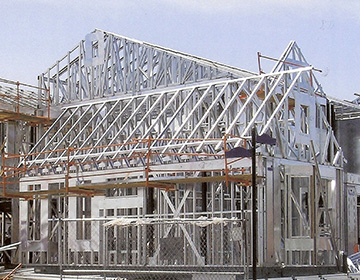
Sturdy warehouse steel structure with high strength, fast construction, large space, fireproof and durable, suitable for industrial storage and logistics.
Contents
- 1 I. Pre-Construction Preparation
- 2 II. Transportation & Stacking of Components
- 3 III. Hoisting Safety & Accuracy
- 4 IV. Bolt Connection Construction
- 5 V. Welding Construction (Critical Control Points)
- 6 VI. Anti-Corrosion & Fireproof Coating
- 7 VII. Accuracy Control & Overall Alignment
- 8 VIII. Key Safety & Civilized Construction
- 9 IX. Acceptance & Documentation
I. Pre-Construction Preparation
Drawing Review & Technical Disclosure
Verify steel component dimensions, joint details, weld grades, and bolt grades.
Clarify hoisting sequence, welding procedures, and anti-corrosion & fireproofing requirements.
Raw Material & Component Acceptance
Ensure steel certificates, quality guarantees, and mechanical property reports are complete.
Inspect components for deformation, rust, coating damage, and groove quality.
Accept high-strength bolts, ordinary bolts, and shear studs by category.
Surveying & Setting Out
Repeatedly check axes, elevations, and anchor bolt positions.
Rectify any excessive deviation of embedded foundation parts before construction.
II. Transportation & Stacking of Components
Prevent deformation, collision, and twisting during transportation; use multi-point supports for long members.
Use level, hardened stacking areas with wooden supports to avoid concentrated stress.
Stack components according to hoisting sequence to avoid secondary handling.
III. Hoisting Safety & Accuracy
Obtain approval for hoisting plans; prohibit overloading, side pulling, and improper lifting.
Regularly inspect lifting points, slings, shackles, and steel wire ropes.
Adjust verticality immediately after steel column hoisting and provide temporary bracing.
Perform rough adjustment then overall alignment for steel beams; avoid forced installation.
Use safety belts, lifelines, working platforms, and safety nets for working at heights.
IV. Bolt Connection Construction
Ordinary Bolts
Achieve 100% hole penetration; no gas-cut hole enlargement.
Tighten nuts in a consistent direction with 2–3 exposed threads.
High-Strength Bolts
Keep friction surfaces clean, free of oil and loose rust; no painting allowed.
Follow the sequence: initial tightening → re-tightening → final tightening.
Calibrate torque wrenches and keep complete torque records.
Apply anti-corrosion treatment promptly after final tightening.
V. Welding Construction (Critical Control Points)
Use only certified welders with complete welding procedure qualifications.
Ensure weld grooves, gaps, and back gouging meet requirements.
Control welding deformation with symmetrical, segmental, skip, and anti-deformation welding.
Visual weld inspection: no porosity, slag inclusion, cracks, or incomplete fusion.
Perform UT/RT non-destructive testing for Grade 1 and Grade 2 welds as required.
Use protective measures in rain, snow, strong wind, and low-temperature conditions.
VI. Anti-Corrosion & Fireproof Coating
Meet required surface preparation standards (generally Sa2.5 or St3).
Comply with designed coating layers and dry film thickness.
Do not pre-coat high-strength bolt friction surfaces or weld grooves.
Strictly follow fire resistance ratings for fireproof coating type and thickness.
Avoid coating in low temperatures, high humidity, or rainy conditions.
VII. Accuracy Control & Overall Alignment
Control indexes: axis deviation, elevation deviation, verticality, and lateral bending.
Perform overall alignment only after the structure forms a spatial rigid unit.
Never unhook or remove bracing before members are fully secured.
VIII. Key Safety & Civilized Construction
Main risks: falls from height and falling objects.
Standardize edge openings, working platforms, and ladders.
Obtain hot work permits, provide fire extinguishers, and assign fire watchers.
Use electricity properly; ground welding machines and ensure undamaged cables.
Set up warning zones and use unified command for cross operations.
IX. Acceptance & Documentation
Accept concealed works: anchor bolts, joint connections, and welds.
Maintain complete documents: material certificates, inspection reports, welding records,
high-strength bolt torque records, and coating thickness records.
Ensure overall structural verticality and deflection tests pass requirements.