


With steady global economic growth and rising public environmental awareness, governments worldwide continue to strengthen environmental supervision. As an effective renovation form for enclosed storage, the steel membrane structure capping project for open coal sheds has become a core measure to satisfy environmental governance requirements, ensure safe production, and achieve standardized coal yard operation. Therefore, coal enterprises and regulatory authorities highly recognize and promote this technical solution.
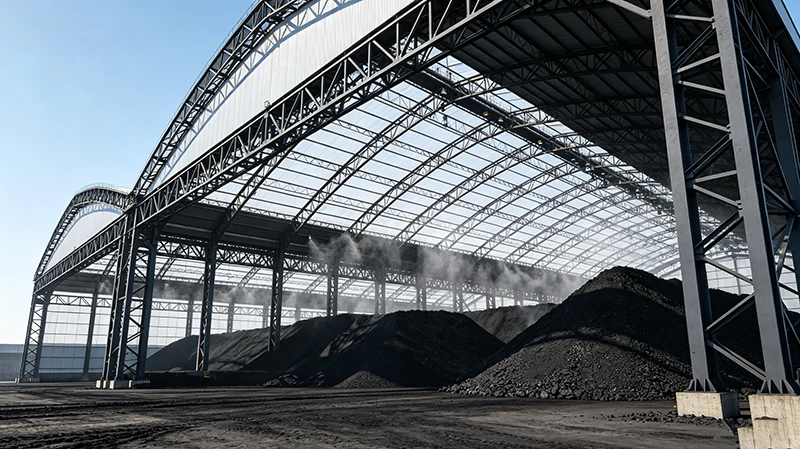
Coal serves as a vital energy resource. If operators stock coal in open yards over extended periods, wind will stir up massive coal dust and severely contaminate the surrounding atmosphere. Complex weather factors including rain, snow, strong winds and high temperatures also trigger coal loss, moisture-induced caking, and even spontaneous combustion. These issues waste energy and create severe hidden safety risks, threatening the daily safe operation of coal yards. At present, steel membrane structures and color steel structures represent the two mainstream reconstruction solutions for covering open coal yards. The building materials adopted by the two solutions differ greatly in performance and inherent features, so they fit distinct application scenarios. Considering the practical functional demands of coal stockpiling, this paper carries out multi-dimensional comprehensive comparison and analysis of the two capping schemes, and delivers practical references for coal yards to select suitable renovation solutions.
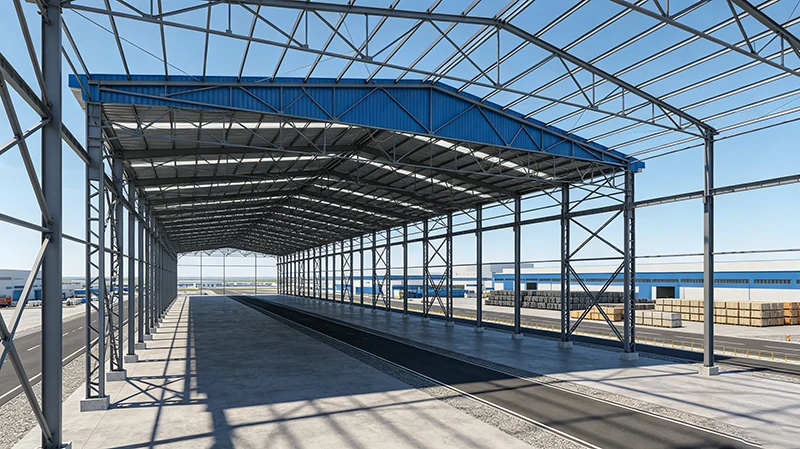
Furthermore, designers must equip enclosed coal sheds with stable, dependable structures that can resist extreme natural disasters including strong winds, torrential rains and heavy snow to maintain structural integrity during harsh weather. Meanwhile, operators need to maintain proper ventilation alongside temperature and humidity regulation inside the sheds. This creates ideal coal storage conditions, slows coal degradation, preserves coal quality, and supports long-term coal stockpiling and efficient downstream usage.
These comprehensive functional requirements constitute the core criteria for evaluating the pros and cons of various coal shed cover-adding schemes. Based on these key conditions, we can carry out a detailed comparison of the performance characteristics of steel membrane structure and color steel structure, so as to clearly judge their applicable scenarios.
The color steel structure coal shed is composed of steel structure grid or I-beam as the core load-bearing skeleton, and color steel tiles are laid on the external enclosure walls and roof. It is a relatively traditional form of coal shed cover-adding and is widely used in small and medium-sized coal yards.
The steel membrane structure coal shed uses steel frames as the basic support structure and selects high-strength and high-performance building membrane materials (such as PVDF membrane materials) as the external enclosure materials. It is an emerging and more advantageous coal shed cover-adding scheme in recent years, and has gradually become the first choice for the renovation of large coal yards by virtue of its excellent performance.
Contents
Performance Comparative Analysis
1. Comparison of Sealing Performance and Environmental Protection Effect
The steel membrane structure coal shed adopts an integrated fully enclosed design, and the special building membrane material used has excellent air tightness, which can form a tight closed space, fundamentally block the outward diffusion of coal dust, effectively control dust pollution, and fully meet the current strict environmental governance requirements. However, during the construction of the color steel structure coal shed, there are many splicing gaps and joints between the color steel plates. Long-term operation of conventional sealing measures may easily cause sealing failure and insufficient overall airtightness. Such defects cannot completely eliminate coal dust leakage, thus weakening the overall environmental governance effect. In contrast, steel membrane structures deliver significantly superior sealing performance and environmental protection outcomes.
2. Comparison of Span and Space Utilization Rate
In terms of structural span design, by virtue of its material characteristics and structural advantages, the steel membrane structure can realize a super-large span column-free design of 60 meters. There is no need to set load-bearing columns inside the shed, which can maximize the use of internal space, not only facilitating the stacking, loading and unloading of coal and other operation operations, but also greatly improving the operation efficiency, which is suitable for the large-scale coal storage needs of large coal yards. In contrast, the span design of the color steel structure is limited by the material stiffness and structural form, and can generally only be controlled between 20 and 30 meters, with a span of only about half of that of the steel membrane structure. More load-bearing columns need to be set inside the shed, which will occupy a certain storage space, resulting in low space utilization rate, and it is more suitable for small and medium-sized coal yards with small building area and limited coal storage scale.
3. Comparison of Weather Resistance and Service Life
The external enclosure color steel tile of the color steel structure has low stiffness.High dust, high humidity and strong corrosion create harsh operating conditions in coal yards, which continuously erode the surface coating of color steel tiles. This long-term erosion easily causes fading, rusting and structural damage. Roofs frequently develop air and water leakage, undermining operational performance and accelerating structural deterioration.
4. Comparison of Cost and Comprehensive Cost
From the perspective of pre-investment cost, the material price of the color steel structure coal shed is relatively low, the construction process is relatively simple, and the pre-construction investment cost is lower, which has a certain cost advantage for small and medium-sized coal yards with limited budgets. However, combined with the service life and later maintenance costs, the color steel structure has a short service life, and frequent later maintenance work will generate a large amount of labor, material and financial expenses, resulting in high comprehensive costs. Although the initial construction investment of the steel membrane structure coal shed is relatively high, its service life is more than 3 times that of the color steel structure, and the membrane material has good weather resistance and stability, so there is almost no need for large-scale maintenance work in the later period, and the maintenance cost is negligible. From the perspective of long-term use, the comprehensive economic benefits are more significant.
Scheme Selection Suggestions
Comprehensively considering various factors such as engineering practicability, safety production performance, environmental compliance and long-term economy, for large coal yards with large coal storage scale, high structural span requirements, strict environmental supervision standards and long-term operation plans, the steel membrane structure coal shed performs better in all aspects of performance, can better meet the long-term use needs of the coal yard, and is a more ideal cover-adding renovation scheme.
Despite various inherent drawbacks, color steel structure coal sheds feature low upfront investment and a short construction cycle. For small and medium-sized coal yards with small storage capacity, low span requirements, limited budgets and short-term service demands, enterprises can adopt such sheds as a transitional solution. This approach enables coal yards to achieve temporary standardized operation while satisfying basic environmental protection and safety criteria.