


We focus on export business and specialize in light steel villas. We clearly understand their core value and development bottlenecks. Light steel villas use light steel as the main structure, integrate modern building technology and environmental materials, and have advantages like fast construction and low carbon. They suit global residential, vacation and rural homestay scenarios but face cost and durability limitations.
Contents
- 1 I. Core Definition of Light Steel Villas (Export Perspective)
- 2 II. Core Advantages of Light Steel Villas for Export
- 2.1 1. Fast Construction Speed for Overseas Efficiency
- 2.2 2. Environmental Protection & Energy Conservation (Global Green Trend)
- 2.3 3. Strong Earthquake & Wind Resistance (Multi-Regional Safety)
- 2.4 4. Flexible Design (Diversified Overseas Aesthetics & Needs)
- 2.5 5. Controllable Quality (Reduce Export After-Sales Risks)
- 2.6 6. Easy Expansion (Fit Overseas Long-Term Needs)
- 3 III. Limitations of Light Steel Villas in Export
- 3.1 1. High Initial Cost (Affects Market Acceptance)
- 3.2 2. Durability & Anti-Corrosion (Needs Climate Adaptation)
- 3.3 3. Limited Sound Insulation (Needs Targeted Optimization)
- 3.4 4. Insufficient Market Cognition (Needs More Promotion)
- 3.5 5. Fire Performance (Needs Optimization for Overseas Standards)
- 3.6 6. Insufficient Regional Adaptability (Needs Customization)
I. Core Definition of Light Steel Villas (Export Perspective)
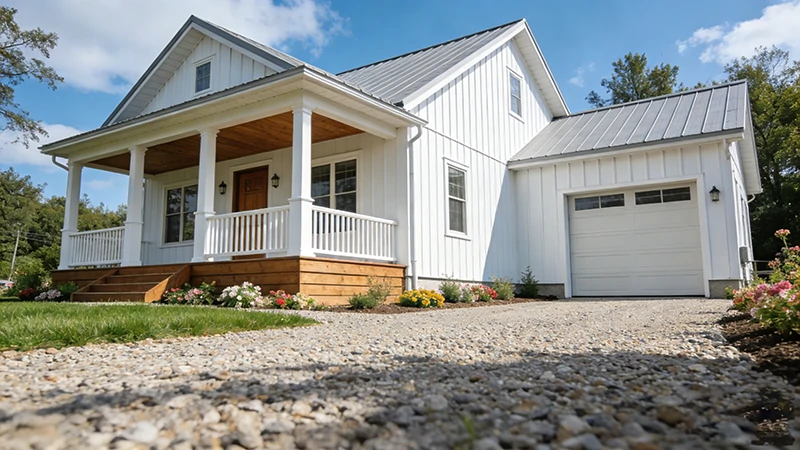
A light steel villa is a residential building with light steel as its main load-bearing system. It uses lightweight wall materials like gypsum board, OSB board and high-efficiency thermal insulation materials. Its core components are cold-formed thin-walled steel, produced through factory prefabrication and on-site assembly in a modular way. This meets the core export needs of standardization, transportability and easy installation. Light steel villas are widely used in global rural self-built houses, tourist homestays and low-rise projects. They are especially suitable for overseas remote areas and tourist resorts, and serve as our core competitive export products.
II. Core Advantages of Light Steel Villas for Export
Light steel villas’ advantages fit overseas market construction needs and policy trends. They become our core competitiveness to expand the international market.
1. Fast Construction Speed for Overseas Efficiency
Light steel villas adopt “factory prefabrication + on-site assembly. We produce all core components in a standardized way in factories, with controllable precision and mass production. We can transport them by container easily for export. Professional teams only need to splice and install them on-site, no complex construction required. Compared with traditional brick-concrete structures, they cut construction time by over 50%. A 200-square-meter villa takes only 1-2 months from foundation to completion. This meets overseas owners’ urgent need to move in and helps developers finish projects quickly, boosting turnover efficiency. It is one of their most attractive export advantages.
2. Environmental Protection & Energy Conservation (Global Green Trend)
Countries worldwide promote green buildings and low-carbon emission reduction. Light steel villas perfectly fit this export trend. First, their materials are highly recyclable. They use galvanized steel with a recovery rate over 90%, meeting global green building standards. This reduces construction waste and local environmental impact. Second, they have superior energy-saving performance. Equipped with polyurethane and rock wool, their walls and roofs insulate better than traditional buildings. They meet the “Design Standard for Energy Conservation of Civil Buildings” (JGJ 26-2018) and most overseas energy-saving requirements, suiting cold northern and hot-humid southern export destinations. Third, they adopt low-carbon construction. Modular construction reduces on-site wet operations, cuts dust and noise pollution, and easily passes overseas environmental acceptance.
3. Strong Earthquake & Wind Resistance (Multi-Regional Safety)
Light steel structures are light, strong, ductile and tough. They can resist earthquakes above magnitude 8, far better than traditional brick-concrete structures. They also have excellent wind resistance, suiting earthquake-prone areas (like parts of Southeast Asia and Southwest Asia) and typhoon-prone coastal countries in Southeast Asia. For overseas markets focusing on residential safety and frequent natural disasters, this safety advantage becomes our key breakthrough to develop the market.
4. Flexible Design (Diversified Overseas Aesthetics & Needs)
The export market has diverse demands. Light steel villas’ flexible design matches different countries’ and groups’ aesthetics and needs. On one hand, their spatial layout is flexible. They adopt large-span design without internal load-bearing walls. We can create open, personalized layouts based on overseas customers’ needs, fitting different families’ living habits. On the other hand, they have diverse appearances. Exterior walls can use exterior tiles, coatings, wood grain siding and other materials. They can create modern, pastoral, industrial and other styles, fitting European, American and Southeast Asian architectural aesthetics and improving export adaptability.
5. Controllable Quality (Reduce Export After-Sales Risks)
We process light steel villa components with CNC equipment in factories, ensuring high precision and small errors. Compared with traditional manual masonry, they have more stable quality, reducing human-caused defects during construction. For export business, stable quality cuts overseas after-sales costs and disputes from construction issues. It improves our international reputation and competitiveness, laying a foundation for long-term export cooperation.
6. Easy Expansion (Fit Overseas Long-Term Needs)
Light steel villas’ modular structure makes later transformation and expansion easy. No large-scale demolition is needed. Customers can add rooms or adjust layouts quickly by adding components to the original structure. This fits overseas customers’ long-term living and operation needs. It supports house type upgrades for families and scale expansion for homestays and vacation houses, further increasing export added value.
III. Limitations of Light Steel Villas in Export
Light steel villas have significant export advantages, but we also recognize their limitations. We need to address these issues to match products with overseas markets when expanding business and serving customers.
1. High Initial Cost (Affects Market Acceptance)
Light steel villas cost more than traditional brick-concrete structures, especially in export. Two main factors cause this: first, material costs. Galvanized steel, high-efficiency thermal insulation materials and supporting components are expensive. Export transportation fees and tariffs push up total costs further. Second, technical costs. Light steel villas need professional design and construction teams. Some overseas regions lack professionals, so we provide additional technical support, increasing service costs. Currently, ordinary light steel villas cost 2000-3500 yuan per square meter for export, much higher than local brick-concrete structures. This creates a threshold for budget-limited overseas customers, such as rural customers in some developing countries.
2. Durability & Anti-Corrosion (Needs Climate Adaptation)
Overseas regions have great climate differences, requiring better durability and corrosion resistance for light steel villas. We use galvanized or aluminized zinc components, but long-term exposure to humid environments and coastal salt spray (like coastal Southeast Asia and parts of Oceania) may cause steel corrosion, shortening service life. Customers also need to regularly inspect and maintain anti-corrosion coatings, increasing later costs. Traditional concrete structures are more durable and require less maintenance, making some overseas customers hesitant.
3. Limited Sound Insulation (Needs Targeted Optimization)
Light steel villa walls use lightweight materials and are thin, so their sound insulation is worse than traditional thick brick walls. Overseas urban residences and buildings near highways need better sound insulation. We need to add extra sound insulation materials, which increases product costs and component transportation volume. This further raises export costs and reduces price competitiveness.
4. Insufficient Market Cognition (Needs More Promotion)
Light steel villas are an emerging building form with low recognition in most overseas markets. Many overseas customers doubt their durability, wind resistance and value preservation. Especially in developing countries, local residents prefer familiar brick-concrete structures, limiting market acceptance. We need to strengthen promotion, show actual cases, and popularize light steel villas’ advantages and usage to improve overseas recognition.
5. Fire Performance (Needs Optimization for Overseas Standards)
Light steel structures are non-combustible, but wall and roof filling materials (like polystyrene board) are flammable. Overseas countries have different fire standards (e.g., stricter EU and US codes). We need to add fireproof coatings and fireproof boards based on export destinations’ requirements to meet local standards. This increases construction costs and export complexity.
6. Insufficient Regional Adaptability (Needs Customization)
Overseas extreme climate regions (alpine, high-humidity, strong ultraviolet) have stricter requirements for light steel villas. We need to optimize their adaptability. For example, we strengthen thermal insulation in alpine regions to reduce winter energy consumption. We optimize wall and foundation waterproofing in rainy, high-humid areas to prevent leakage. We improve exterior wall materials in strong ultraviolet regions to enhance aging resistance. Customization improves adaptability but increases design and production costs, raising higher requirements for our export supply chain.
In general, light steel villas have broad export prospects. Their high efficiency, environmental protection and flexibility fit the global construction trend and become our key export growth point. We also face their limitations. We will solve export problems through technical optimization, cost control and market promotion, improve product competitiveness, and help light steel villas enter a broader international market.