


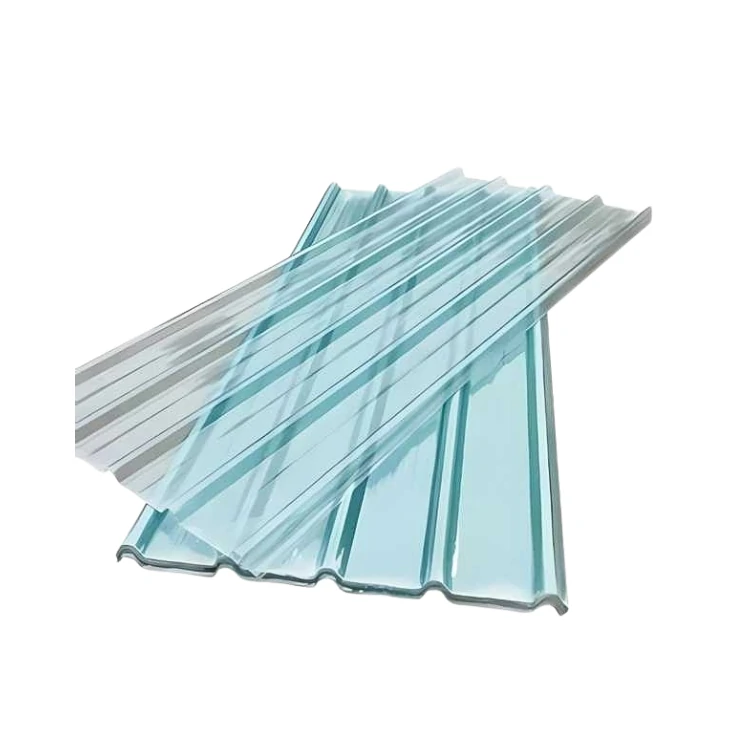
The core advantages of FRP Daylight Roofing Sheets lie in strong corrosion resistance, soft light transmission, low cost, long service life and good installation adaptability. They are especially suitable for scenarios such as chemical plants, coastal areas and greenhouses, and their comprehensive cost performance is significantly superior to glass, color steel tiles, PC sheets and ordinary plastic tiles.
Contents
I. Comparison with Glass Daylighting Panels
-
Safe and Impact-Resistant: The impact strength is 2–20 times that of tempered glass. It is not easy to break in hail and typhoons, and there is no risk of falling.
-
Lightweight and Load-Reducing: The density is about 1.4–1.5g/cm³ (half of glass), which reduces roof load and support costs.
-
Wider Temperature Adaptability: Suitable for -40℃ to 120℃. Glass is easy to crack at low temperatures and expand and crack at high temperatures.
-
Lower Cost: Material and installation costs are lower than glass, with less damage and maintenance.
-
Soft Light: Diffused light transmission without glare or light spots, protecting eyes and ensuring comfort.
II. Comparison with Color Steel Tiles (Non-Daylighting)
-
Natural Daylighting: Light transmittance is adjustable from 25% to 90%, reducing lighting energy consumption by more than 40% during the day, saving energy and costs.
-
Strong Corrosion Resistance: Resistant to acid, alkali and salt fog, no rust in chemical plants and coastal areas; color steel tiles are prone to corrosion and water leakage.
-
Waterproof Matching: Can be lapped with color steel tiles in the same wave shape, with good sealing and reliable leakage prevention.
-
Heat Insulation and Noise Reduction: Better heat insulation and sound insulation than single-layer color steel tiles, improving indoor comfort.
III. Comparison with PC Polycarbonate Sheets
-
Superior Corrosion Resistance: Resistant to acid, alkali and organic solvents, the first choice for chemical workshops; PC is not corrosion-resistant and is easily eroded by chemicals.
-
Lower Price: About 20% cheaper than PC sheets of the same thickness, making projects more economical.
-
Wave Shape Adaptability: Can be customized to the same tile shape as color steel plates for seamless lap joint; most PC sheets are flat, making matching difficult.
-
Anti-Aging and Stable: High-quality products have a service life of 15–20 years, with light transmittance attenuation ≤15% in 20 years; PC is prone to yellowing under long-term UV radiation, with a service life of 10–15 years.
-
Installation-Friendly: Low thermal expansion and contraction coefficient, nail holes are not easy to crack, and leakage prevention is worry-free; PC has large expansion and requires reserved space.
IV. Comparison with Ordinary Transparent Plastic Tiles (PVC/PE)
-
Longer Service Life: Durable for 15–30 years, while ordinary plastic tiles are prone to aging and brittleness in 3–5 years.
-
Higher Strength: Fiberglass reinforced, with strong bending and impact resistance, not easy to deform or crack.
-
Fire-Retardant and Safe: Can reach B1 grade flame retardant, no molten dripping when burning; ordinary plastic tiles are flammable and have the risk of molten dripping.
-
Stable Light Transmittance: Anti-UV coating, with little long-term light transmittance attenuation; ordinary plastic tiles are prone to yellowing and sudden drop in light transmittance.

Summary Table of Core Advantages
|
Comparison Dimension
|
FRP Daylight Roofing Sheets
|
Glass
|
Color Steel Tiles
|
PC Polycarbonate Sheets
|
Ordinary Plastic Tiles
|
|---|---|---|---|---|---|
|
Corrosion Resistance
|
★★★★★
|
★★☆☆☆
|
★☆☆☆☆
|
★★☆☆☆
|
★★★☆☆
|
|
Light Transmittance
|
★★★★☆ (Soft)
|
★★★★★ (Dazzling)
|
☆☆☆☆☆
|
★★★★★ (Clear)
|
★★★☆☆ (Easily Attenuated)
|
|
Impact Resistance
|
★★★★☆
|
★☆☆☆☆
|
★★★★★
|
★★★★★
|
★★☆☆☆
|
|
Service Life
|
15–30 Years
|
10–20 Years
|
5–10 Years
|
10–15 Years
|
3–5 Years
|
|
Price
|
Medium-Low
|
High
|
Medium
|
High
|
Low
|
|
Installation Adaptability
|
★★★★★
|
★★☆☆☆
|
★★★★★
|
★★☆☆☆
|
★★★☆☆
|
Typical Application Scenarios
-
Industrial: Chemical plants, electroplating plants, fertilizer plants (strong corrosion environment).
-
Agricultural: Greenhouses, breeding sheds (soft light promotes growth and prevents dripping).
-
Public: Warehouses, markets, carports (impact-resistant and energy-saving).
-
Coastal: Areas with heavy salt fog (corrosion-resistant and typhoon-resistant).