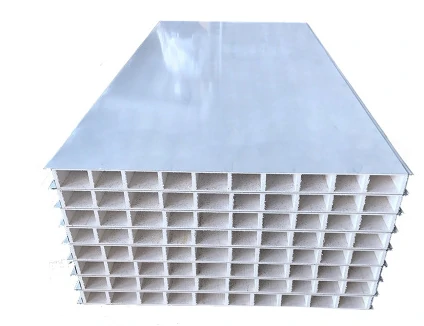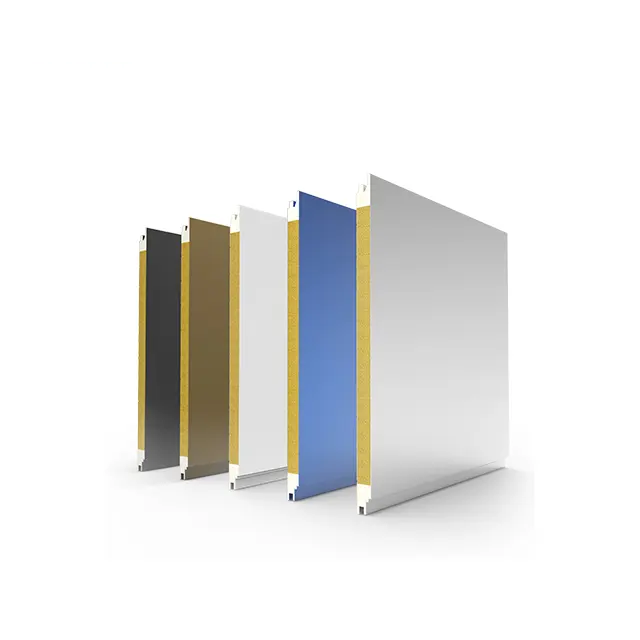


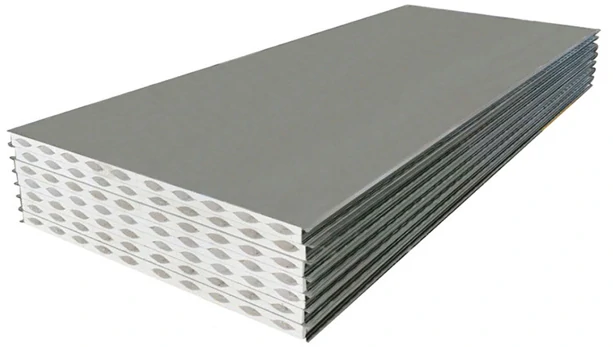


Magnesium Oxysulfide Panels are widely used in the following areas:
Construction: As wall and ceiling panels in residential and commercial buildings.
Fireproofing: In fire-rated assemblies for enhanced safety.
Acoustic Insulation: To reduce noise transmission in various environments.
Industrial Applications: For partitions and enclosures in factories and warehouses.
Green Building: As an eco-friendly alternative in sustainable construction.
1. Air-hardening property
Unlike ordinary silicate cement, magnesium oxysulfate board has a different setting and curing mechanism. It is an air-hardening cementitious material and does not harden in water.
2. Multi-component structure
Magnesium oxysulfate board is multi-component. Single-component lightly calcined powder, after hardening with water, has virtually no strength. Its main components are lightly calcined powder and magnesium sulfate, with other components including water, modifiers, and fillers.
3. Mild and non-corrosive to steel
Magnesium oxysulfate board uses magnesium sulfate as a binder. Compared to magnesium oxychloride fireproof board, it does not contain chloride ions and is non-corrosive to steel. Therefore, magnesium oxysulfate board can replace magnesium oxychloride cement in fireproof door core panels and external wall insulation panels, reducing the risk of chloride ion corrosion to steel.
4. High strength
After modification, magnesium oxysulfate board can achieve a compressive strength of 60 MPa and a flexural strength of 9 MPa.
5. Air Stability and Weather Resistance
Magnesium oxysulfate board is an air-hardening cementitious material, which can only continue to solidify and harden in air, giving it excellent air stability. After curing, the drier the air in the environment, the more stable the magnesium oxysulfate board becomes. Tests show that the compressive and flexural strength of magnesium oxysulfate fireproof board products increase with age in dry air, continuing to increase even after two age periods, demonstrating excellent stability.
6. Low Temperature and Low Corrosion