


Our Hot-dip Galvanized Cattle Shed is an agricultural facility built specially for livestock farms. This product relies on hot-dip galvanizing to protect its steel pipe frame. The process creates a tough, silvery-white anti-corrosion coating.
Strong corrosion resistance and stable structure stand out as core advantages. Quick onsite installation also saves lots of construction time. This modular design fits large-scale breeding projects perfectly.
Its core purpose is to create long-lasting shelter for livestock. Furthermore, it cuts your long-term maintenance costs year after year. It works great for standardized beef cattle and dairy cow breeding.
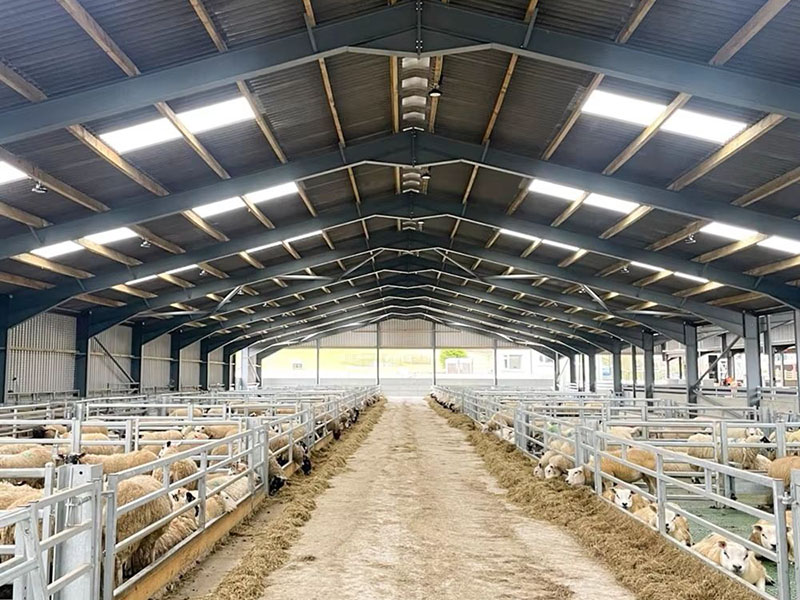
Many traditional barns carry hidden risks, such as rusted collapsing frames and frequent repairs. Severe livestock stress responses also hurt farm productivity. Our shed solves these common farm pain points effectively.
Содержание
- 1 1. Technical Principle, Technical Specifications & Structural Design
- 2 2. Site Selection, Operation & Installation Specifications
- 3 3. Technical Advantages, Field Performance & Comparison with Traditional Barns
- 4 4. Selection & Screening Guide (Avoid Pitfalls)
- 5 5. Application Scenarios & Expandability
- 6 6. Common Construction & Operation Mistakes
- 7 7. Routine Maintenance Guidelines
- 8 FAQ
1. Technical Principle, Technical Specifications & Structural Design
Core Technical Parameter Table
| Item | Технические характеристики | Примечания |
|---|---|---|
| Steel Treatment | Hot-dip galvanizing | We do NOT use cold galvanizing or spray galvanizing |
| Zinc Coating Thickness | ≥65μm | It delivers 3~5 times better corrosion resistance than standard cold galvanizing |
| Main Column Pipe | φ76×2.75mm / φ89×3.0mm | Upgrade to φ89×3.5mm for high-wind and heavy-snow areas |
| Beam Pipe | φ60×2.5mm / φ76×2.75mm | |
| Bracing Pipe | φ48×2.0mm | |
| Fittings | Hot-dip galvanized bolts, angle brackets, gaskets & connection plates | We hot-dip galvanize all metal fasteners. This avoids galvanic corrosion. |
| Designed Wind Resistance | Level 10 (28.5m/s) | We offer custom upgrades to Level 11 for high-wind regions |
| Designed Snow Load | 0.3m snow depth (0.6kN/㎡) | We offer custom upgrade to 0.5m snow load for heavy snow regions |
| Standard Single Span | 8m / 9m /10m /11m /12m | We build custom non-standard spans up to 15m |
| Eave Height | 3.0m / 3.2m /3.5m /4.0m | We recommend ≥3.2m for beef barns, ≥3.5m for dairy barns |
| Roof Pitch | 1:4 (approx.14°) | Balances drainage, snow sliding and natural lighting |
| Bay Width (Column Spacing) | 2.0m~2.5m | Reduce to 1.8m in high wind & heavy snow zones |
| Design Service Life | ≥15 years | With regular proper maintenance |
| Собственный вес | 8~12kg/㎡ | Only 40% of brick-concrete barns |
How The Hot-dip Galvanizing Process Works
Workers submerge steel pipes into molten zinc liquid in the hot-dip galvanizing process. This forms a zinc-iron alloy layer thicker than 65μm. The alloy layer blocks air and moisture effectively.
Livestock farms hold high levels of ammonia gas and wet manure. On the other hand, ordinary steel pipes quickly rust and develop holes. Our zinc-iron alloy layer slows frame aging and chemical corrosion greatly.
Truss Frame & Solar Reflective Design
The steel pipe frame uses a triangular stable truss structure. Bolted joints spread stress points evenly. Therefore, the frame resists Level 10 wind and 0.3m snow cover.
For different regions, we increase pipe wall thickness or narrow column spacing. This adjustment raises the structural safety margin.
The silvery galvanized coating reflects sunlight. As a result, it stabilizes temperature inside the shed and lowers livestock stress. It also reduces feed intake drops and milk yield loss caused by summer heat stress.
Most barns use a gable double-slope roof design. Builders reserve ridge vents for drainage and natural ventilation. Columns, beams and braces all use hot-dip galvanized steel tubes.
We also hot-dip galvanize all bolts and gaskets. In particular, this stops galvanic corrosion from dissimilar metals and prevents early accessory failure.
Orient the barn facing south with a 10‑15° east offset. This layout maximizes winter sunlight and blocks harsh direct summer sunlight.
2. Site Selection, Operation & Installation Specifications
2.1 Pre-construction Site Selection
Choose high, dry land. Keep underground water level below 2m and guarantee good drainage. Build the land with a natural slope of 1%‑3%. This slope drains rainwater and manure smoothly.
Avoid low-lying flood-prone land and exposed windy sites. Meanwhile, keep enough biosecurity distance from residential zones and other farms. Make sure water, electricity and forage transport routes are easy to access.
Reserve space for manure storage tanks. In addition, build separate systems for rainwater and sewage.
2.2 Installation Procedure
We use modular assembly design. Workers pour concrete foundation piers in advance. They embed anchor bolts inside the piers.
Adjust pier size and steel reinforcement based on soil bearing capacity. Use larger reinforced foundations on soft ground. This prevents settlement and tilting.
Our factory manufactures all components ahead of time. Teams deliver parts to your site and assemble everything with bolts directly. We do not weld on-site, because on-site welding damages the zinc coating from high heat. Our turnkey service finishes construction in just 3‑5 days.
Optional roof covering materials:
- PC Solid Sheet: 80% light transmittance, thickness 2.0mm / 2.5mm /3.0mm, UV-resistant and anti-aging
- UV-protected PVC Tarpaulin: 0.6~0.8mm thickness, UV stabilized, optional flame retardant function
Adjust light intensity based on your breeding needs. Add sunshade nets for hot regions. Alternatively, install thermal insulation tarpaulins for cold regions.
We reserve mounting spots for rolling curtains on side walls. You can install electric rolling curtain systems later. These systems flexibly manage ventilation, wind shielding and thermal insulation.
Routine Coating Maintenance Tips
Check galvanized coating integrity and wipe surface dirt once every year for daily maintenance. You do not need extra anti-corrosion treatment.
Stop sharp objects from scratching the zinc layer. Cattle horns and metal equipment can damage the coating easily. Use cold galvanizing repair paint for temporary fixes on local damage. This stops rust from spreading outward.
2.3 Recommended Auxiliary Infrastructure
Reserve feeding aisles, manure removal aisles and manure drainage ditches inside the shed. Build ditches with a 1‑2% slope. Route the flow to external manure collection tanks and add cement waterproof plaster.
Pre-install interfaces for automatic feeding, scraper manure cleaners and drinking troughs. Insulate water supply equipment to avoid freezing in cold regions. Furthermore, reserve mounting brackets for fans and evaporative cooling pads in hot regions.
3. Technical Advantages, Field Performance & Comparison with Traditional Barns
Our Hot-dip Galvanized Cattle Shed cuts self-weight by 60% compared with traditional brick-concrete barns. It lowers foundation load requirements and works well on soft soil.
The steel frame lasts over 15 years. That is 3 times longer than wooden structures. It carries no risk of insect borers. Our turnkey installation saves your time on material sourcing and construction coordination.
We offer a 1-year warranty. It covers installation quality and material defects. For example, one thousand-head farm case data shows barn maintenance costs dropped by 40%. Livestock morbidity fell by 15%. The data proves stable structure directly improves breeding efficiency.
| Comparison Item | Hot-dip Galvanized Modular Cattle Shed | Brick-concrete Barn | Ordinary Color Steel Shed | Wooden Shed |
|---|---|---|---|---|
| Срок службы | Over 15 years | 20‑30 years | 5‑8 years | 4‑6 years |
| Foundation Requirement | Light weight, suitable for soft soil | Heavy weight, high bearing requirement | Средний | Низкий |
| Construction Period | 3‑5 days (turnkey) | 30‑60 days | 15‑25 days | 10‑20 days |
| Устойчивость к коррозии | Excellent, resists ammonia & moisture in livestock farms | Walls durable, steel fittings rust easily | Color steel plate perforates and rusts easily | Rot and insect damage happen easily |
| Modification & Relocation | Detachable, relocatable & expandable | Hard to relocate, hard renovation | Heavy loss after disassembly, hardly reusable | Scrapped after disassembly |
| Overall Cost | Medium, high cost-performance | High initial cost | Low upfront cost, high replacement cost | Cheap at first, high total cost from frequent replacement |
However, it delivers weaker thermal insulation than fully enclosed brick-concrete barns. Add thermal rolling curtains and wind barriers in cold regions. The frame alone cannot provide enough winter insulation.
4. Selection & Screening Guide (Avoid Pitfalls)
Many suppliers mix hot-dip galvanizing, cold galvanizing and spray galvanizing. Buyers need to check these key points carefully:
- Confirm hot-dip galvanizing. Reject cold (electro) galvanizing. Cold galvanizing creates thin coating. It develops heavy rust within 3‑5 years in high ammonia and humid breeding environments.
- Verify zinc coating ≥65μm and adequate pipe wall thickness. Do not accept thin-wall tubes. Cattle impact deforms thin pipes easily.
- All bolts and fittings must use hot-dip galvanizing. Ordinary galvanized bolts rust first and trigger structural failure.
- Avoid heavy field welding. Welding burns off zinc coating and causes fast rust on welds. High-quality modular products use full bolt assembly.
5. Application Scenarios & Expandability
You can adjust span and height (standard span 8‑12m, eave height 3‑4m). This structure works for sheep, horse and other livestock besides cattle.
We support custom fabrication. You can add extra ventilation windows, automatic feeding system interfaces, milking equipment pre-position and isolated calving compartments.
Lightweight design supports disassembly and relocation. It fits rented land or farms with adjustment plans. Moreover, you can extend the shed longitudinally during farm expansion. You do not need demolition work.
The galvanized coating meets agricultural environmental standards. You can recycle steel pipes after decommissioning. This cut downs environmental pollution.
- Suitable Scenarios: Large-scale beef feedlots, free-stall dairy barns, cow maternity barns, sheep sheds, horse stables.
- Not Recommended Scenarios: Fully enclosed maternity barns that need strict winter insulation in cold regions; sites near factories with strong corrosive chemical fumes.
6. Common Construction & Operation Mistakes
- Only focus on pipe price and ignore fittings: Frame pipes meet standards, but bolts & brackets use ordinary galvanized steel. These parts rust fast and create safety hazards within 2‑3 years.
- Cut corners on foundations: Soft soil without reinforcement leads to foundation settlement and frame tilt.
- Insufficient eave height: Eaves lower than 3m block air circulation. Heat accumulates in summer and worsens heat stress.
- Neglect ventilation design: Builders only add rain & sun protection. No ridge vents or side ventilation openings. Ammonia builds up and causes respiratory diseases.
- Weld or cut the frame randomly. This destroys galvanized anti-corrosion layer and creates fast rust on weld seams.
- Poor rain-sewage separation: Manure water soaks pier bases long-term and speeds erosion of foundations and pipe bottoms.
7. Routine Maintenance Guidelines
- Run two inspections every year (spring & late autumn). Check foundation settlement, bolt tightness and scratches on galvanized coating. Repair damaged spots quickly with cold galvanizing paint.
- Clean manure and dust on roof and frame regularly. Manure residue speeds zinc layer corrosion.
- Stop scrapers and buckets from hitting стальные колонны during mechanical manure cleaning.
- Inspect drainage around pier bases in rainy seasons. Do not allow long-term ponding of rainwater and manure near column bottoms.
- Clear roof snow during heavy snow weather. Remove snow before depth hits the 0.3m design limit. This prevents overload collapse.